
For many machine builders, after-sales support has traditionally been a reactive activity.
On-site interventions, travel, lengthy diagnostics, and limited access to machine information still represent a significant part of service operations today.
However, this model is changing rapidly.
The growing adoption of industrial connectivity is transforming the way OEMs manage technical support, maintenance, and after-sales service.
From Reactive Support to Connected Service
Over the past few years, an increasing number of machine builders have adopted remote access and data collection platforms to improve the management of their installed machine fleet.
This enables them to:
- Reduce intervention times
- Accelerate issue diagnosis
- Minimize unnecessary on-site visits
- Improve technical support
- Increase production uptime and customer satisfaction
But the real transformation goes beyond operational efficiency.
Fast and secure access to machine information enables OEMs to move from a purely reactive approach to a more proactive and structured service model.
Industrial Connectivity and Cybersecurity: Finding the Right Balance
One of the main barriers to industrial connectivity adoption is cybersecurity. End users are increasingly focused on:
- Access management
- Connection traceability
- Network segmentation
- VPN management
- Cybersecurity compliance
For this reason, modern remote access platforms must deliver not only operational simplicity, but also governance, security, and full control over remote connections.
Industrial connectivity is no longer just a technical feature.
It is becoming an essential part of the machine lifecycle management strategy.
From Connectivity to Digital Services
Data collection and secure remote access are only the first step. Today, many OEMs are already looking beyond connectivity toward:
- Advanced analytics
- Overall Equipment Effectiveness (OEE)
- Predictive maintenance
- Centralized machine fleet management
- Cloud integration
- AI-driven service applications
As a result, the value is no longer limited to the installed machine itself, but increasingly lies in the ability to build digital services around the data generated by that machine.
Connectivity and Machine Architecture: Two Parts of the Same Evolution
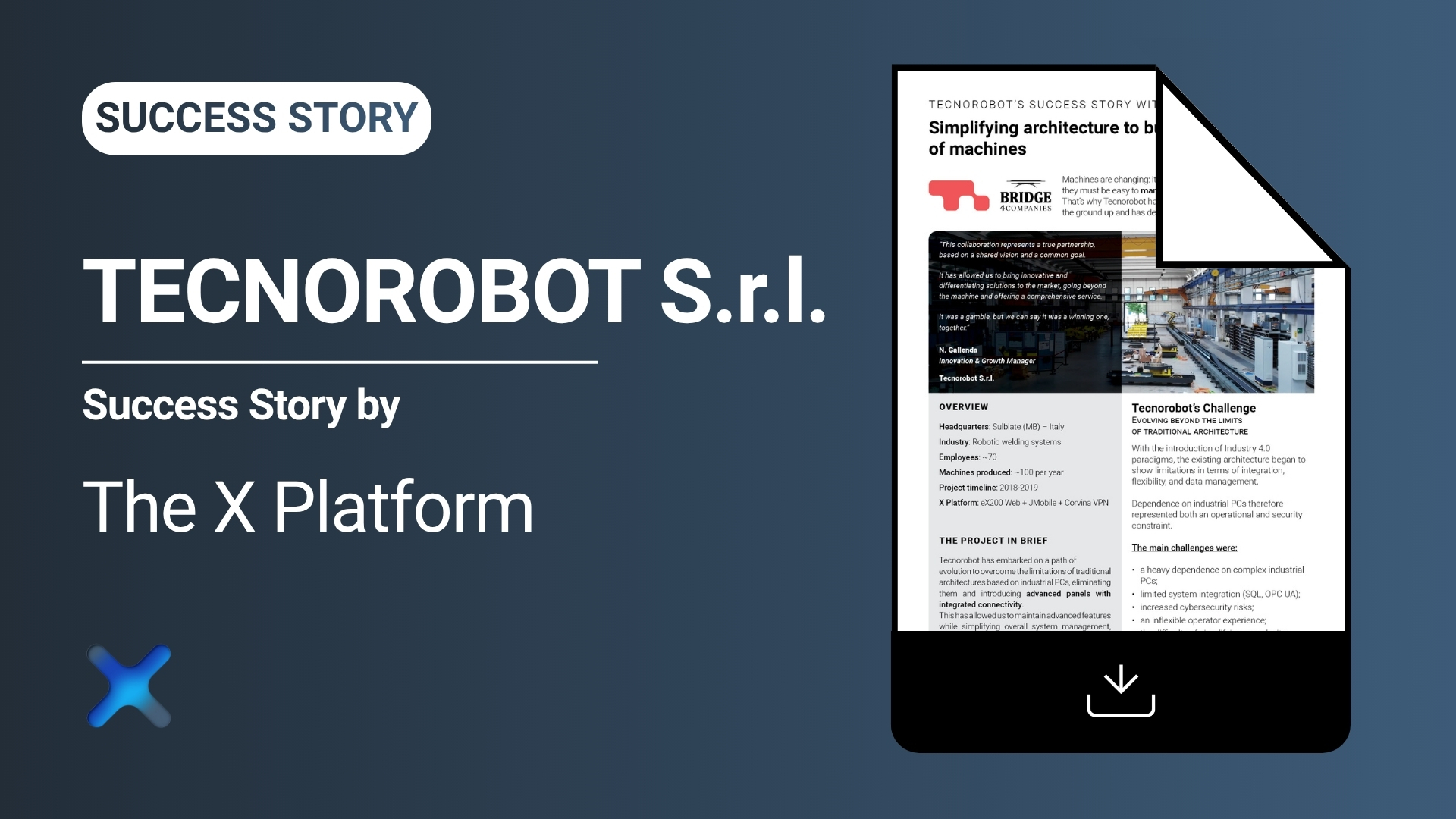
In the project developed with Tecnorobot, connectivity was designed alongside the evolution of the machine architecture.
The Corvina platform enabled secure remote access, data collection, and more efficient service management, while EXOR technologies simplified the machine architecture by eliminating the industrial PC.
Together, hardware, software, and industrial connectivity created a platform ready for future developments, including centralized control rooms, advanced analytics, and new digital service offerings.
This approach demonstrates that the real value today is no longer limited to the machine itself, but lies in building an ecosystem capable of supporting its continuous evolution.
The Future of Industrial Service
In the coming years, industrial connectivity will become much more than remote assistance. It will increasingly serve as a strategic enabler to:
- Improve operational efficiency
- Develop new service business models
- Increase the value of after-sales support
- Build stronger, long-term relationships with customers
Companies investing in industrial connectivity today are not simply creating connected machines. They are laying the foundation for the next generation of industrial services.


