
In modern industrial environments, flexibility, safety, and operational efficiency are no longer optional. As production lines become more dynamic and machines are increasingly reconfigured to meet changing demands, operators must be able to position themselves exactly where their intervention brings the most value. This is why portable HMI technology has gained an essential role in the digital transformation of factories. Portable HMIs provide the ability to monitor, adjust, and control machinery while moving freely around the equipment, significantly improving setup time, troubleshooting precision, and the ergonomics of daily operations.
However, “mobility” in an industrial context does not simply mean moving around with a tablet. It requires robust communication, reliable safety behavior, intuitive handling, and a design that respects the realities of harsh industrial environments. Among the different technological approaches to mobility, wired portable HMIs remain the simplest and most predictable entry point. They offer the mobility operators need while maintaining the reliability of a physical connection.
The wired approach delivers several advantages that many machine builders and manufacturing plants still consider essential. First, it provides uncompromising communication stability. In environments where electromagnetic interference is high or where radio signals might be unreliable, a wired connection ensures consistent data flow and machine responsiveness. Second, wired portable HMIs represent the most cost‑effective way to introduce mobility into a machine design, which is ideal for projects that need predictable investment levels and minimal integration complexity. Third, the setup process is straightforward: cable, device, and you’re ready to go. For engineering teams working with tight deadlines, simplicity is a winning factor.
Of course, a physical cable introduces certain constraints. Depending on the design, the cable can be rigid or heavy, which may limit the operator’s range of motion compared to more advanced solutions. In addition, unplugging the device typically opens the emergency loop; an expected behavior for many wired systems, though bypass options exist. Despite these limitations, wired portable HMIs continue to be widely adopted because they strike the right balance between mobility, safety, cost, and ease of deployment.
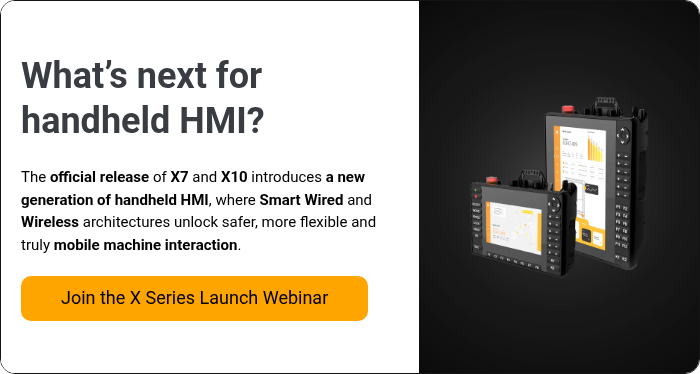
This is the context in which X7 Wired and X10 Wired models from EXOR International have been designed. These devices are not simply another set of handheld HMIs added to the market; they represent a modern interpretation of what wired mobility should be today. Built on EXOR’s long experience in industrial visualization, the X7 and X10 Wired versions combine a renewed ergonomic design, improved operator handling, and the robustness expected from a professional industrial HMI.
Although detailed specifications will be presented during the official launch webinar, the key idea behind these models is clear: offer a reliable, modern, and ergonomically refined entry point into portable HMI technology. For manufacturers looking to simplify their workflow while maintaining strict safety and communication requirements, the wired versions of X7 and X10 are the ideal starting point.
As the industry moves toward more advanced mobility solutions, the wired approach remains highly relevant. It is a trusted foundation on which both machine builders and plant managers can rely, especially when taking the first steps toward flexible operator interfaces. And while the upcoming X7/X10 Wireless and Smart Wired versions will soon expand the portfolio, the Wired models represent the baseline that ensures every plant can begin its transition confidently, affordably, and with the robustness typical of EXOR solutions.
If your goal is to improve operator efficiency and bring mobility to industrial operations without complexity, the X7 and X10 Wired offer the perfect combination of dependability, usability, and value. And this is only the beginning of what the new portable HMI platform will deliver.
